The Digital Chisel: How AI Helps Me Spec & Build Custom Furniture
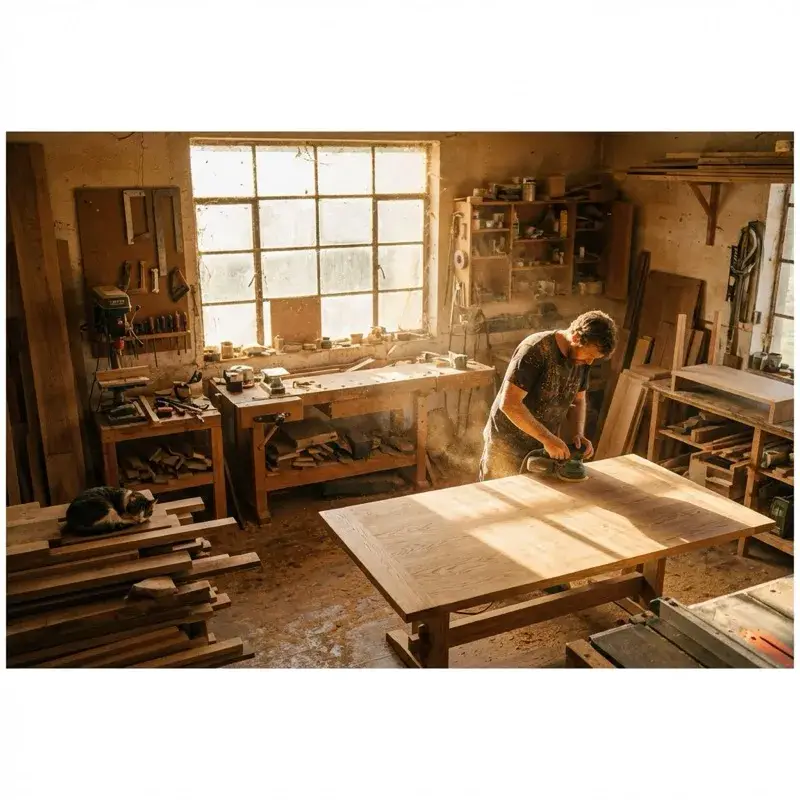
Woodworking is a craft rooted in centuries of tradition, but that doesn't mean we can't use 21st-century tools to ensure every cut is perfect and every design is optimized.
Lately, friends and clients have asked me how a "traditional" woodworker like myself uses Artificial Intelligence. It might seem like a contradiction—hand tools meeting neural networks—but AI has become a powerful assistant in the planning phases. It helps me spec out complex pieces, visualize structural solutions, and communicate with clients before a single board is milled.
Precision in the Planning Phase
One of the biggest challenges in custom furniture is converting a client's "vibe" into technical specifications. A client might say, "I want a mid-century modern credenza that feels sturdy but looks light." Translating that feeling into dimensions requires both artistic intuition and mathematical precision.
I use AI-driven tools to assist with the initial brainstorming and rapid prototyping of ideas. By inputting constraints—such as room dimensions, intended load (e.g., will it hold a heavy TV or just picture frames?), and preferred wood species—I can generate multiple iteration options in minutes rather than hours. This allows me to present you with a "menu" of possibilities, refining the design until it clicks.
Furthermore, AI helps calculate material yields. Wood is expensive, especially premium hardwoods like Black Walnut or White Oak. Advanced nesting algorithms can analyze my cut list against the available board feet to minimize waste. This isn't just about saving money; it's about respecting the tree. Every scrap saved is a piece of nature preserved.
Visualizing the Impossible
Before AI, explaining a complex joint or a unique grain pattern required hand sketches that often left clients guessing. Now, I can use generative design tools to create mood boards and even textural simulations.
For example, if you're torn between a natural oil finish or a darker stain, I can use digital tools to simulate how those finishes might look on a specific grain pattern under different lighting conditions. This helps eliminate the "surprise" factor on delivery day. You know exactly what you're getting, down to the way the light hits the bevel on the table edge.
Optimizing Wood Movement and Stability
Wood is a living material. It breathes. It expands in the humid Cedar Rapids summers and contracts in the dry, heated winters. A table top can widen by a full quarter-inch or more across its width. If the joinery doesn't account for this, the piece will crack or self-destruct.
AI helps verify my structural assumptions. By analyzing the expansion coefficients of specific species (like the difference between Plainsawn and Quartersawn White Oak), I can double-check my tolerance calculations. It acts as a second set of expert eyes, reminding me, "Hey, that breadboard end needs slightly longer slots for the pins if it's living in a sunroom."
This digital "stress testing" ensures that the heirloom-quality piece I build for you today will still be functional and beautiful 50 years from now, regardless of the Iowa weather.
Case Study: The Cantilevered Desk
Recently, I worked on a design for a floating, cantilevered desk. The client wanted it to look like it was defying gravity, with no visible supports.
Computationally, this is a physics problem. How thick does the walnut top need to be to resist sagging over a 6-foot span? Where is the tipping point? Using simple AI modeling scripts, I was able to determine the exact placement for the hidden steel sub-frame required to support the wood.
The result? A desk that looked delicate and impossible but was rock-solid enough to dance on (though I don't recommend that!). The technology allowed us to push the boundaries of the design without risking structural failure.
The Human Touch Remains
Despite all these high-tech tools, the soul of the work remains analog. AI can calculate a cut list, but it can't feel the grain direction to know which way to plane without tearing out fibers. It can't smell the difference between fresh oak and cured pine. It can't run its hand over a sanded surface and know that it needs "just one more pass" with 220 grit.
I view AI as the ultimate apprentice. It handles the math, the sorting, and the visualization, clearing the way for me to focus on the craftsmanship. It allows me to spend less time with a calculator and more time with a chisel in hand.
The heart of White Angus Woodworks is, and always will be, the skilled hands of the craftsman. Technology just helps those hands work smarter.
Frequently Asked Questions
How is AI used in woodworking?
AI assists woodworkers in the planning phase by generating design iterations from client constraints, calculating material yields to minimize waste, simulating finishes on specific grain patterns, and verifying structural calculations for wood movement and load-bearing capacity.
Can AI replace traditional woodworking skills?
No. AI handles math, optimization, and visualization, but it cannot feel grain direction, judge surface quality by touch, or make the split-second decisions required during hand-tool work. AI is best used as a planning assistant that frees the craftsman to focus on hands-on craftsmanship.
What AI tools do custom furniture makers use?
Custom furniture makers use AI-driven tools for cut-list optimization and material nesting, generative design for rapid prototyping, finish simulation to preview stain and oil results, and structural analysis to verify load-bearing and wood-movement tolerances before building.
Does AI help reduce wood waste?
Yes. Advanced nesting algorithms analyze a cut list against available board feet to find the most efficient layout. This reduces offcuts, saves money on premium hardwoods, and respects the resource by using more of every board.
Can AI account for wood movement in furniture design?
AI can analyze the expansion coefficients of specific species and sawing methods (plainsawn vs. quartersawn) to verify tolerance calculations. It acts as a second set of expert eyes, flagging potential issues like undersized breadboard slots or insufficient seasonal clearance.
The Digital Shop Challenge
Test your knowledge of high-tech woodworking tool and techniques.
Across
- 4 A structural beam supported at only one end
- 5 The arrangement of design elements on a page or surface
Down
- 1 Computer Numerical Control (machinery automation)
- 2 Mathematical paths used by design software for precise cutting
- 3 A piece of furniture where logic and craft meet